Industrial Noise Monitoring Compliance with uNoise: A Case Study
Introduction
In France, industrial noise regulation follows the Installations Classified for Environmental Protection (ICPE) framework. Under it, the industrial sites classified as ICPE are subject to strict obligations under the Environmental Code, with noise considered a regulated environmental nuisance alongside air, water, and soil emissions.
For most industrial sites, this compliance can be achieved through the ‘acoustic emergence’ of sound levels, i.e., the difference between ambient noise levels during the plant operations and the residual background noise when the plant is idle. These regulations become even more stringent when the Industrial operations are surrounded by residential spaces. The difference in noise emissions becomes the point of contention that reflects a key regulatory principle: the real impact of an industrial activitymust be assessed in relation to its surrounding environment. In practice, this means that project owners need to always ensure compliance and put corrective measures in place before faced with sanctions or penalties.
This makes monitoring, measurement, and source attribution particularly challenging in environments where multiple noise sources coexist.
Why traditional noise monitoring was not sufficient
Most industrial noise monitoring solutions typically rely on Class 1 sound level meters (SLM), which provide just the acoustic measurements. While indisputably essential, most sound level meters reach their limits when questions of noise origin arise.
In this case, standard SLM could not reliably answer:
Whether an exceedance was caused by the coating plant or by external sources?
Whether residual noise levels, even after appropriate measures are in place, reflected plant activity or environmental background?
How to justify mitigation efforts when global noise indicators remained high?
As a result, investigations risked becoming assumption-based, time-consuming, and difficult to defend.
Source: Canva
The Challenge for the Industrial Client
An industrial client in France operating an asphalt coating facility faced, noise regulations posed a constant threat of sanctions and shutdowns. Geographically, the industrial plant is located very close to residential housing. Nearby residents regularly reported noise disturbances, often pointing fingers at the factory. Although the operator had already implemented structural and operational modifications to reduce noise emissions from the plant, overall environmental noise levels still posed a regulatory roadblock. The client faced a familiar noise monitoring dilemma:
The surrounding environment already generated significant ambient noise (weather, traffic, and other activities).
Average sound levels were therefore unlikely to decrease dramatically.
Yet they needed to demonstrate that the noise generated by the plant had been significantly reduced.
For the client, the challenge was to build their compliance evidence that indicated that mitigation measures were effective on site; and that the noise that was beyond their control was actually off site. The quality of evidence needed should also withstand the scrutiny from consultants, regulators, and local stakeholders.
Source: Canva
The on-site approach implemented by UBY
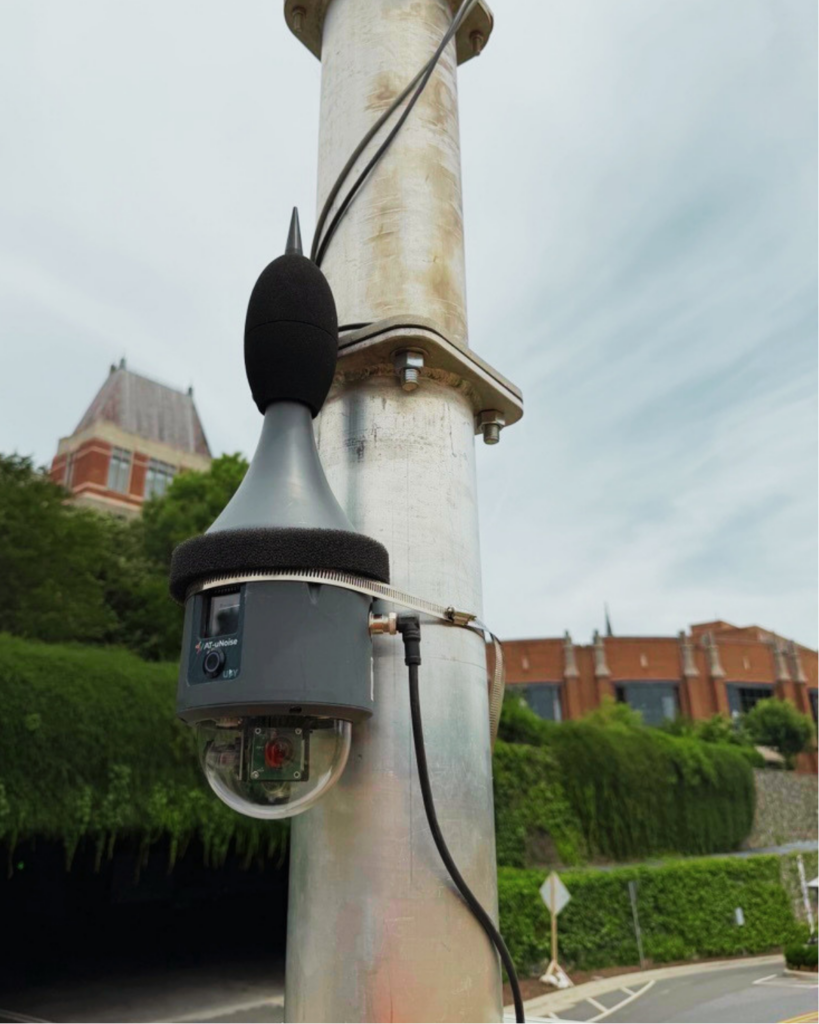
To address these limitations, the UBY project team first executed a methodological environmental consulting approach. They took into account all the existing parameters including the A-weighted sounds generated by the plant and the possible regions where excess noise has been identified. On narrowing down to the most noise polluting region, they selected a Class 1 (the norms NF EN IEC61672-1 and IEC61260-1) noise sensor, uNoise, that complies with international regulatory standards. This sensor also included 3 directional microphones positioned as a tetrahedron to capture sound waves from different directions and using acoustic triangulation, pinpointing the noise direction in real-time. The source turned out to be traffic from the nearby route.
But to provide irrefutable compliance data, the asphalt coating factory also needed visual proof of the noise exceedance source originating externally. With uNoise, they could capture 180° or 360° images of the site and the surroundings. Combining the acoustic triangulation with the images and AI-noise detection, they could identify the nuisance source with concrete evidence. Eventually, they were able to refute false claims and avoid sanctions on the plant.
Normally, this approach would involve a SLM and a separate camera, while noise identification without AI was a laborious task involving audio files listening for hours. For the client, using the uNoise saved the cost associated with managing multiple sensors for audio recording, audio analysis, and visual proof. Additionally, the environmental consultant on the project did not spend hours analyzing the data and could spend more time suggesting mitigation methods. As the sensor was fully automated, no manual survey was needed; just a stable Wi-Fi connection sufficed. Importantly, while this generated large amounts of data, the retrieval was selective, limiting bandwidth usage while preserving analytical depth, giving a key operational advantage in long-term industrial noise monitoring.
Combining it with the uMonitor platform meant that site visualizations were robust, and any noise exceedance alert could be cross referenced with other sensors on the site if needed. Furthermore, the platform automatically calculates LAeq and other regulatory metrics, eliminating manual data processing. Lastly, reporting that often took hours to collate the data, now could be customized and automated to be sent regularly to the stakeholders.
Thus, the project team could clearly identify the noise sources, which often turned out to be external. It also demonstrated clearly that the asphalt plant had taken all the measures it can to mitigate the noise. During inspections or complaints raised by residents, the industrial plant owners could establish defensible compliance and protect themselves from regulatory risk.
A broader lesson for industrial noise monitoring
This case illustrates a growing reality for industrial operators and regulators alike: compliance tools are used out of necessity, but not all are sufficient. When industrial plants are faced with constant regulatory threats, gathering hard facts becomes obligatory to avoid any fines for temporary operations restriction or halting production.
In complex acoustic environments, effective noise monitoring hinges on three things:
Metrological robustness: Class 1 measurements along with visualization of the noise ensure regulatory credibility.
Integrated source discrimination: Direction, audio recognition, and visual context can be correlated in a single workflow, reducing reliance on assumptions.
Operational efficiency: Easier deployment, targeted data retrieval, and faster investigations reduce both field effort and analysis time.
By combining compliant noise measurement with source discrimination and contextual analysis, a more transparent, efficient, and credible approach to industrial noise management can be achieved, aligning with both regulatory expectations and real-world operational challenges.
Our UBY Structure case studies
UBY Structure, uMonitor
Coastal Cliff Monitoring with GNSS: Improving Long-Term Risk Assessment
Continuous GNSS monitoring combined with uMonitor helps assess coastal cliff instability over the long term. Understand why installation quality matters ...