
In-Place Inclinometer (IPI): continuous soil deformation monitoring
What is an In-Place inclinometer?

An In-Place Inclinometer (IPI) is a measuring instrument used to monitor the horizontal deformation of soils or deep foundations.
Unlike inclinometer probe (used for manual measurement), it remains permanently in an inclinometer tube. Furthermore, this tube is sealed in the element to be monitored after drilling. It is made up of a series of rigid segments, each incorporating a sensitive part (called inclinometers). These segments are linked together by mechanical connections (pivot type) to form a “chain”. Finally, this chain is deployed and guided in a grooved inclinometer tube, allowing the collection of a set of angular measurements (1 point per segment). The integration of these measurements makes it possible to determine an angular deformation over the entire length of the tube. This measurement method requires a fixed point, usually at the base of the borehole. Typically an anchor is also installed at a depth between 5 and 7.5m.
What are the different IPI models on the market and how to choose?
- This measuring system exists in different models according to the following characteristics:
- The transmission mode
- Analogue
- Digital
- The length of the segments and the spacing of the measuring points:
- 0,5 meter
- 1 meter
- 2 meter
The length of the segments is chosen according to the level of representativeness of the desired deformation phenomenon. The shorter the segments, the more inclinometers the chain contains, allowing for detailed analysis of the deformation point(s).
It is important to note that the number of segments is directly related to the cost of the device. So, an interesting configuration can be where the spacing is adapted to the expected deformations.
For example, imagine a case where two geological layers are subject to horizontal slip, one between the surface and 10m depth and the second less noticeably from 10 to 20m depth. The project designer could recommend using an IPI with non-uniform segment lengths. Longer segments can be proposed at the bottom of the borehole, where the expected deformations are less. And to increase the number of measurement points at the interface between the two layers and down to the surface, shorter segments can be placed.
One of the great strengths of the In-Place Inclinometer is its continuous collection of measurements and real-time transmission. It can take several measurements per hour with a static interrogation module, or even several measurements per minute with a dynamic interrogation module).
If inclinometric monitoring is to be proposed, the choice will be more towards In-Place inclinometer if
- the expected phenomena require near-real time monitoring
- the length of inclinometric tubes to be measured would be too time-consuming in terms of manual measurements, or
- access to the tubes is too delicate (co-activity, inaccessible tube head, etc).
In other cases, the choice will be more towards a manual survey.
What type of measurement is obtained?
This type of device provides a uni-axial or bi-axial deformation depending on the type of sensor used. A uni-axial measurement allows a single deformation to be obtained along the axis of the expected deformations. This is typically towards the front of a retaining wall during an excavation operation. Alternatively,a bi-axial measurement is interesting in cases where the expected deformations are in the horizontal plane.
STRUCTURAL AND GEOTECHNICAL MONITORING
Managing the integrity of your construction sites and maintaining safety of surrounding infrastructures
Our solution allows you to optimise your construction processes by leveraging the full potential of the observational method.
In what form can the data be read?
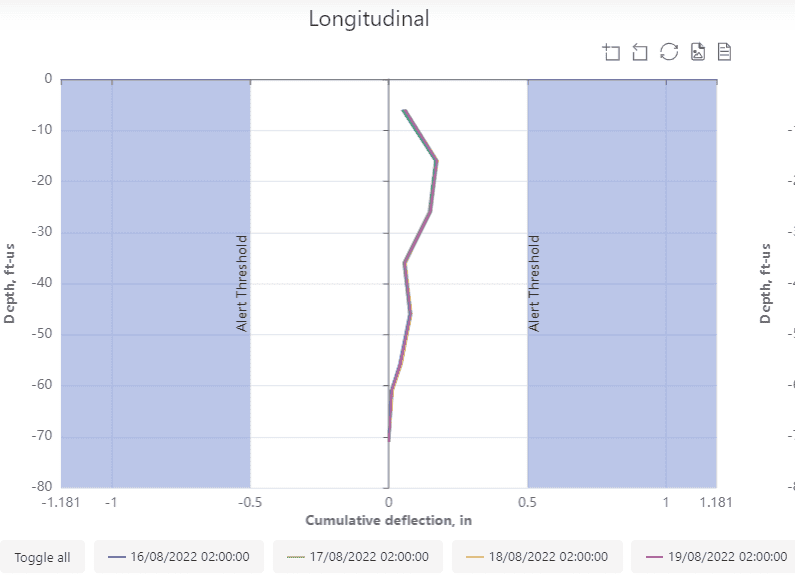
Structural data collection platforms, such as uMonitor, analyse the various angle measurements transmitted by the chain and make them intelligible through graphs, by time interval. The thresholds generally defined by the project owner or a stakeholder (e.g. the SNCF has imposed soil deformation thresholds on its network in operation, located around the Greater Paris works) are visible from this same graph.
Use case example: Monitoring ground movement during tunnel boring
This device is regularly used to monitor impacts during tunneling. In the case of reinforced measurement sections requiring an increase in the number of measurements (sensitive surroundings in the area, area of geotechnical In the case of reinforced measurement sections requiring a higher number of measurements (sensitive neighbours in the area, geotechnical interest, cadence, or other), it is often requested to deploy inclinometric measurements to measure the earth pressure of a Tunnel Boring Machine (TBM) during its passage. These measurements can be used to monitor the deformation of the ground during the passage of the active zone, to monitor the deformation of the ground around the deep foundations of sensitive existing buildings or to correlate the measurements with the soil surveys previously carried out.
The use of inclinometric measurements can also be used to determine the ovality of the retaining walls when the TBM arrives in a centred structure. Additionally, it can be used when a tunnel connection branch is excavated in a non-centred structure, and/or to monitor the impact of the arrival of the excavation face on the deformation of a spandrel.
This ground movement monitoring should be coupled with topographic measurements wherever possible for greater redundancy. This is because inclinometer tubes may be lost due to blockage or bending, or because of topographic targets that are subject to dirt, degradation, delicate topographic sights, etc.
GOOD TO KNOW
In-Place Inclinometers (IPI) can be installed from the natural ground, or in retaining walls or piles.
In the first scenario, the driller is usually responsible for installing the pipe during drilling. If the ground is weak, a temporary casing may be necessary.
Conversely, in the second scenario, the installation of a reservation tube is essential during the installation of the reinforcement cages to facilitate the drilling operations. The driller can then lower his drill string to the bottom of the casing, drill a hole in the bottom of the wall (to guarantee anchoring in a stable zone), and install the inclinometer tube before sealing.
Alternatively, ShapeArray (SAA) can be considered to monitor the ground movements based on the project requirements.
Related sources
[FR] Rapport bibliographique : Observation des glissements de terrain – Nouvelles technologies d’instrumentation in-situ, Mars 2015, CEREMA
[FR] Méthodes d’auscultation de la structure, Auscultation des fondations, Les collections de l’IFSTTAR, Octobre 2021